
The leaders speak a lot of confidence with the employees. What if the real challenge was not to talk about it, but to win it?
It is not because we have launched a well -established discourse on the confidence on the intranet of the box or that we published an inspiring message on LinkedIn only authorization, this confidence exists.
Confidence is rather a set of small gestures, signals that can be perceived on a daily basis. The way in which a manager transmits information, the place given to others during a meeting on Teams, or even the little sentence added at the bottom of an email. All these gestures are not simple “moments of communication”, but are cultural markers of a company.
And this culture, well, it can be reinforced, as weakened by these recurring little gestures.

Employees do not lack info, they lack alignment
At a time when the internal channels are overflowing with content (intranet, groups and teams team/slack, internal newsletters, business videos, etc.), it is not the quantity that creates confidence, but the quality of signals.
Weak signals, which do not seem honest, come to create a gap between what is said by management and what is experienced/felt. This generates discomfort or a feeling of falsehood, also called cognitive dissonance.
A dissonance that leads directly to:
- Frustrated collaborators;
- A loss of motivation;
- A quality of work that declines;
- Isolated employees.
But above all, this progressive disconnection weakens collective engagement. Employees no longer clearly understand the priorities, lose the meaning of their contribution, and sometimes end up disengaging silently. Ultimately, this can impact overall performance, slow down internal initiatives, and make transformations more difficult to carry.
And that, no organization is fond of it.
Communication embodied by employees
Internal communication is changing its face. The long dominant top-down diagram is no longer enough. Today, it is the voices of collaborators who create confidence, commitment and who manage to make their way in informational noise.
The most in advance companies do not seek to supplant these voices, but to amplify them. They invest the channels already used by employees and favor meaning rather than overload.
Concretely, this involves new formats that resonate with the way employees connect to each other:
- Employee Resource Groups which become influence relays
- Internal podcasts to broadcast key messages
- Communication between peers, deployed on a large scale
- The content generated by employees, a guarantee of authenticity and credibility
- Employees’ advocacy as a real strategy
- And even the mail signature, transformed into a powerful and measurable point of contact
These levers are not accessories: they embody a new, more authentic corporate culture, carried by those who live it on a daily basis.
Transform everyday contact points
When internal communication is designed for alignment, even the most commonplace gestures become coherence levers. Take the email signature: identical for all roles, visible in each team, sent thousands of times each week.
It is not rehearsal, it is range. Each email becomes an opportunity to strengthen the brand, culture and clarity on a large scale. Far from being a simple administrative space, the signature turns into a strategic asset: discreet, but revealing of identity, confidence and intention.
With a centralized platform like Lesignitcompanies can go far beyond the simple display of contact information. They create signatures that convey messages that accompany each employee: persistent, visible, subtly powerful. In short, they make the alignment fluid.
Concretely, this opens up new possibilities:
- Internal communication teams Can disseminate targeted messages, visible only internally: training launch, mentoring program, or mini-watering to prepare a seminar.
- Marketing teams They can activate the product notoriety, promote offers or teases an event, directly integrated into outgoing emails.
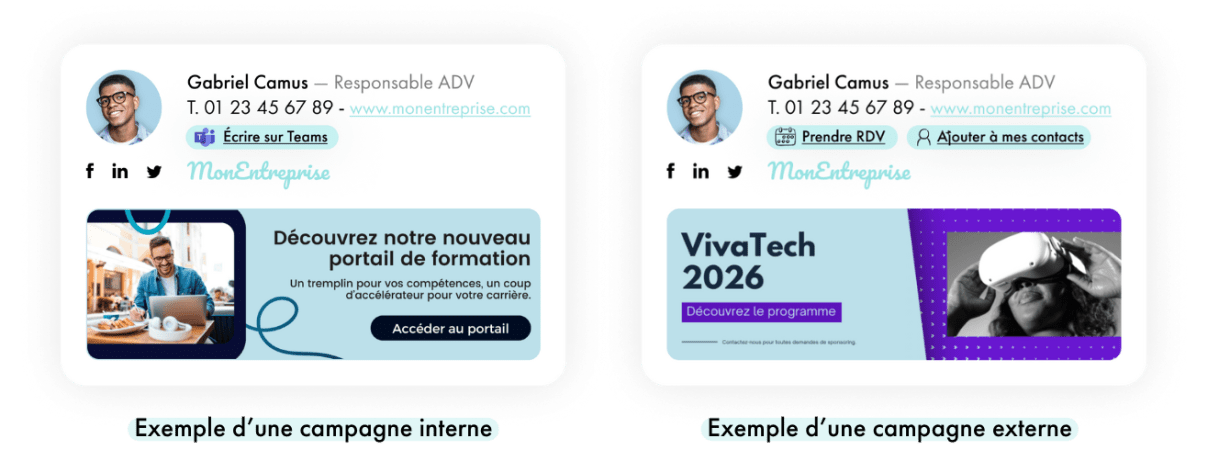
- Customer Success teams Can relay satisfaction surveys integrated into a single, familiar and friction channel for the customer.
- Banners and messages Can be adapted by role, region or language and evolve in real time with the strategy.
That’s it, to design for confidence and relevance: messages that travel with those who send them.
When communication managers build around the way people really exchange, confidence ceases to be a goal.
It becomes the new standard.
