
AI has profoundly changed the way Internet users search for information. They no longer just enter a few keywords: they describe a need, provide context, compare, ask for advice and expect an immediate response.
The deployment of Google’s AI Previews in France, on July 22, 2026, is part of this evolution. Search becomes conversational and answers are increasingly produced directly in the interface. For e-commerce sites, this transformation does not only raise the question of their visibility in generative engines, in other words GEO. It also changes buyers’ expectations once they arrive at a store.
Because the real point of friction is no longer just when finding a product. It moves towards the moment of deciding to buy it.
Good research does not answer every hesitation.
Effective e-commerce search is essential. It should understand typos, synonyms, imprecise queries or natural language formulations. Above all, it must help a visitor quickly access the right product, rather than leaving them facing an empty or irrelevant results page.
But, by definition, a search only knows what is present in the catalog.
 However, the buyer who consults a product sheet is not always looking for a precise reference. He may be unsure about the delivery time, the return conditions, the choice of a size, the composition of a material or the compatibility of the product with his needs. On a decoration site, he will want to check if a custom curtain suits the width of his bay window. In sport, he will seek to know if a shoe is suitable for regular practice. In fashion, he will ask if a material is warm, fits large or can be turned inside out.
These questions are rarely structured in a product feed. They may be found in an FAQ, a delivery policy, a size guide, an advice page or may not have been anticipated by the merchant. However, they intervene at the most critical moment of the journey: when the purchasing intention already exists, but trust is not yet complete.
It is on this last stage that Doofinder evolves its AI Assistant.
The AI Assistant arrives on product sheets.
The second version of Doofinder’s AI Assistant no longer only intervenes in search. It is now present on Product Pages, product sheets, in order to answer questions that appear when the visitor has to decide.
The change seems simple. It is actually structuring for the e-commerce experience.
An e-commerce AI assistant should not be limited to reformulating a product sheet or returning a list of links. It must understand a question expressed in the customer’s own words, identify the information that will resolve their doubt and provide a useful answer without interrupting the purchase. According to Doofinder, its AI Assistant can mobilize the necessary information beyond just the catalog and knowledge base, to also answer questions to which the merchant has not explicitly provided it with an answer.
This is a decisive point for reducing searches without results. “Zero results” does not always correspond to the absence of a product. It can also reflect the absence of an answer to a concrete question: Can I be delivered before Friday? Does this product support outdoor use? What is the difference between these two references? Can I return a custom order?
In a traditional journey, the visitor will have to look for an answer elsewhere on the site, open several tabs, contact support or leave the store. With an Assistant integrated into the product sheet, information can be brought where it is needed, at the exact moment it can trigger the decision.
Conversion is in the details.
For e-commerce managers, improving the e-commerce conversion rate is not just about optimizing traffic, design or loading speed. It’s also about removing the micro-frictions that tip a buyer from clear intent to abandonment.
The last doubts are often the most costly, because they concern visitors already engaged in the journey. They found the product, consulted the sheet and sometimes even compared several options. But the lack of response on delivery, returns, size or actual use of the product is enough to postpone or cancel the purchase.
The issue goes beyond immediate conversion. When a visitor cannot find information, they contact customer service. However, a large part of these requests concern recurring questions, to which the company could respond instantly if the information was accessible and contextualized. AI for e-commerce sites can then play a dual role: better support the buyer and reduce pressure on operational teams.
Provided, however, that you do not add a layer of complexity to the journey.
This is the logic carried by Doofinder. The AI Assistant is designed to intervene fluidly between the search and the product sheet, without forcing the visitor to leave their route or the merchant to launch a cumbersome integration project. Its activation requires neither specific training nor complex configuration announced on the client side.
From the search tool to the Research and Discovery platform.
This development sheds light on the repositioning of Doofinder. The company, still often identified in France by the internal search bar, presents itself as a platform for Research and Discovery.
Search helps find what the visitor already knows to look for. Discovery also makes it possible to reveal what he did not know how to formulate, to bring an intention closer to a product and to guide a decision. In an environment where queries become longer, more conversational and more contextual, this ability to understand intent becomes central.
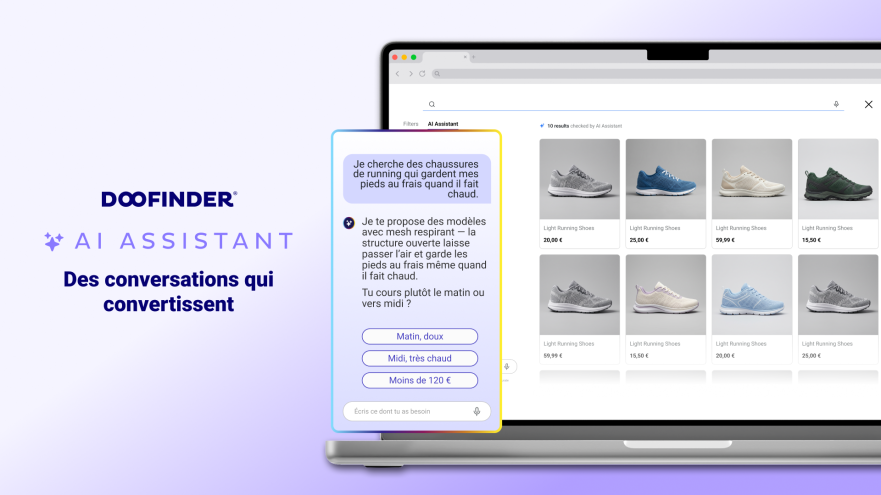
Doofinder thus combines several building blocks: e-commerce search, recommendations and AI assistant. The point is not to pile on features, but to create continuity between the stages of the journey: understanding the need, guiding you towards the right products, explaining the differences and responding to objections before purchasing.
For merchants, this continuity also makes it easier to read the signals left by their customers. Queries without results, repeated questions or hesitations about a category become usable data. They may reveal missing content, poorly worded information, a merchandising problem or an opportunity to expand the offering.
The assistant therefore also becomes a tool for observing real demand.
A concrete case.
 Search is already having a measurable impact on e-commerce performance. Stores-et-rideaux.com, a French SME specializing in custom blinds and curtains, made in France, observes a conversion rate with Doofinder of 11%.
The company especially highlights the behavioral gap between visitors using search and others:
“We find that users who use search are twice as likely to purchase as those who don’t use it. Doofinder therefore plays an important role in our conversion and directly contributes to our turnover. »
This case illustrates a simple reality: when a buyer quickly finds what they are looking for, they are more likely to complete their purchase. The extension of the AI Assistant to product sheets aims to extend this benefit to the moment when the customer is no longer just looking for an item, but for confirmation.
An integration evaluated by Shopify.
Doofinder now boasts more than 10,000 user stores and is one of Shopify’s certified technology partners.
This certification is not a simple commercial referencing. To integrate the Shopify Technology Partner Directory, a solution is evaluated in particular on its usefulness, its infrastructure, its performance, the quality of its support, its confidentiality practices and a security assessment carried out by a third party organization. For merchants, particularly those operating on Shopify Plus, this is a concrete benchmark in choosing a solution: the application has been examined according to demanding standards, beyond its sole product promise.
As generative interfaces change search habits, stores will no longer just have to worry about how to bring in traffic. They will also have to make sure they know how to answer, precisely and at the right time, the questions that separate interest from purchase.
This is where an essential part of the e-commerce experience now lies: no longer just in the ability to display a product, but in that of helping the customer make their decision.
Discover Doofinder with a 15-day free trial, without commitment or credit card >
