
Entrepreneurs in their quest for success are always looking for mEntrepreneurs, in their quest for success, are always looking for methods to ensure that they have chosen the right strategy, but also for relevant ideas that allow them to be immediately operational.
Mind mapping has become essential for entrepreneurs, because it perfectly corresponds to developments in the internet, collaborative cloud tools and our new ways of communicating. As a result, mind mapping has established itself in numerous training courses and within companies as an effective method for successful brainstorming, analysis and project management meetings.
Indeed, highlighting links helps generate ideas and facilitate the relevance of the argument. Moreover, mind mapping is often proposed as an excellent substitute for the linear presentation methods usually used (such as traditional slides), which limit creativity and do not allow the generation of new ideas.
The mind mapping method, a tool for entrepreneurs
A Mind Map, also called a topogram, heuristic diagram or mental map, is a method which consists of mapping one’s thoughts on a visual support. Thus, it allows us to use the untapped resources of our brain and to develop our intellectual skills.
Indeed, mind mapping allows you to:
- Think clearly, creatively and originally
- Develop your imagination
- Determine the causes of a problem
- Develop agile strategies
- Make meetings effective
- Optimize project management
- Improve internal communication
- Structure your ideas and those of the group (prioritize, classify and compare)
- Develop our memory
- Improve your reading speed and quality
- Take notes more efficiently
- Optimize the analysis of complex documents
- Boost your daily productivity
- Instantly view interactions
- …
For example, during a meeting, this method makes it possible to adapt to all participants by leaving room for their ideas while allowing the analysis to be rigorously organized.
But how to carry out a mind mapping?
In the center of a sheet placed in landscape format (or a touch screen):
- The whole forms a logical and visual tree with its branches and branches.
- The theme of reflection is symbolized by an image, a word or a precise objective positioned in the center.
- The main ideas start from this image or objective in the form of branches.
- Each branch is associated with a keyword, a color or an expression drawn or printed on a line.
- Secondary and peripheral ideas are represented as “branches” connected to the main branch.
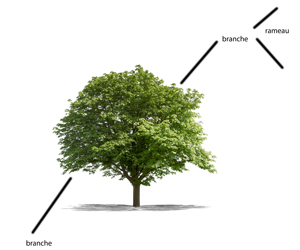
In fact, mind mapping transforms a tedious linear list. Take the example of a roll of papyrus that had to be unrolled to read the entire contents, which made reading sequential and difficult; let’s compare it to the book, which, through its structure, allowed direct access to information and accelerated understanding. The mental map is the “book” of our visual age.
Mind maps for all aspects of professional life
Mind mapping is not locked into a rigid model to be duplicated. On the contrary, it suggests thinking with powerful tools that adapt to all aspects of modern professional life. Here are the main variations:
- The manual map (on paper or whiteboard)
- The computer card (via software and SaaS applications)
- The brain activation map
- The note-taking card from an oral speech
- The note-taking card from a piece of writing
- The memory card
- The brainstorming card
- The corner card
- The project map
- The presentation card (alternative to PowerPoint)
- The checklist card
- The Content Writing and Design Map
- The spider card
- The decision tree
- The Lean Canvas (for start-ups)
- The repositionable note wall (visual Kanban type)
- The Venn diagram
- The Gantt chart (time planning)
- The Pert diagram
- The storyboard
- The personal social network map (networking)
- The interest diagram
- The influence diagram
- The QQOQCCP (Who, What, Where, When, How, How Much, Why)
- SPRI (Situation, Problem, Resolution, Information)
- And many more.
A clearer, more natural and more efficient way to use our brains
The Mind Map uses the overall potential of our brain, the two hemispheres of which have complementary capacities. It thus stimulates a person’s full capabilities. It allows us to seek out buried ideas using images and pictograms that will stimulate our deep creativity.
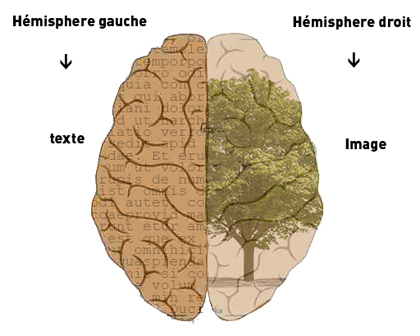
A theory based on research carried out on the cerebral hemispheres
According to Dr. Roger Sperry, researcher and Nobel Prize winner, the newest part of the brain — namely the cerebral cortex — is divided into two hemispheres responsible for carrying out a whole series of complementary tasks: logic, rhythm, linearity, colors, lists, daydreaming, numbers, imagination, language and global vision.
He found that the brain gains considerably in efficiency if both hemispheres are used simultaneously, with each mental faculty contributing to enhancing the performance of the others. Thus, the Mind Mapping method implements the fundamental capacities of the brain to retain and process information by exploiting all of the possibilities of the cortex. Furthermore, as the review points out ScientificAmerican :
“Images have a much greater evocative power than words and are more likely to trigger multiple associations of ideas, thus promoting creative thinking and memorizationation. »
Tony Buzan and Mind Mapping
Tony Buzan is at the origin of the modeling and dissemination of the mind mapping method. He emphasizes in his numerous works that any individual who studies the nature of human memory and the major roles of the brain is inevitably fascinated by its remarkable abilities. Attractive in its fun and stimulating side, Mind Mapping is nevertheless a technique of astonishing power for the business world. By using this tool, you will discover how to take advantage of the incredible abilities of your brain.
In conclusion, psychologist Tony Buzan applied this mind mapping method to contemporary managerial issues: by better organizing his ideas, the manager prepares himself effectively for action and gains a decisive impact on a daily basis.
