The period of turbulence is not far ahead of companies but ahead of them with every day news that calls into question all strategies, all communication plans. While many entrepreneurs are looking for a plan B to get out of the impasse, others are looking for opportunities to develop their growth.
In this particular period of 2026, managers face many difficulties including the gap between their vision and that of their colleagues, discouragement among employees, uncertain confidence in the future as well as the feeling of not being perceived at their true value. Now more than ever, leaders need support points to carry out their thoughts and make decisions.
The Ikigai method, kesako?
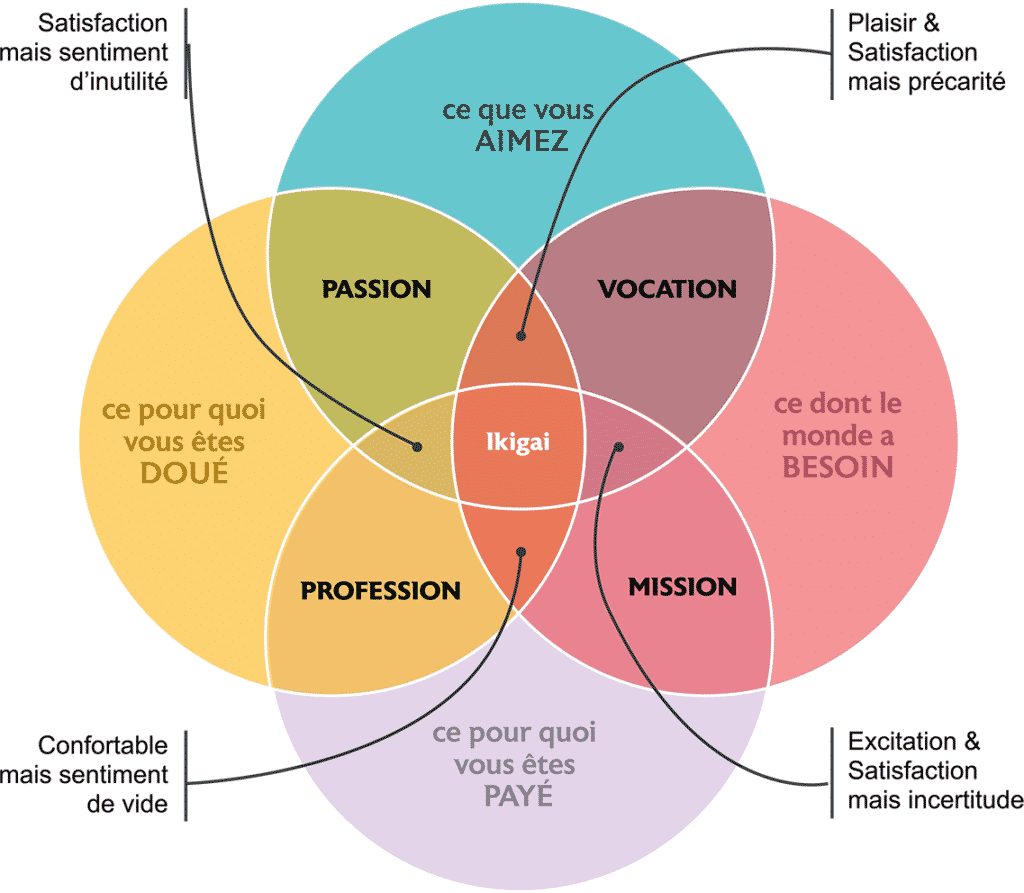
The Japanese method of “Ikigai”, that is to say discovering one’s reason for being, helps to understand how we can find ourselves in complex situations according to our way of living and feeling. Our emotions become filters in our actions and in our relationships with others that we must take into account.
Almost everyone knows, through the example of multifaceted glass, the differencethis vision depending on the position where you are in relation to the glass. Not aware of this different visiontogether, we are trained to choose and sometimes wrongly since we have a limited vision of reality while we are convinced that we understand reality objectively and of our ability to make decisions taking into account what we perceivens.
Through this situation we make judgments which can be detrimental to the other collaborator or client whereas if we took the trouble to look at the other side of the glass, we could understand the vision and ideas of the others. Thus the discoverynumber of ideas or realities would be favored, which would make it possible to opt for bettertheir choices.
What are these different perceptions that lead us to act without objectivity?
Stick to your first impression
For example in recruitment or in meeting a client and therefore make a judgment and not seek to have other perceptions.
Take credit for yourself and only blame others for your failures.
It’s Voltaire’s fault… Many leaders tend to believe that their successes are exclusively their fault, because they are the founders and that to get there, they had to face a host of difficulties but that the failures are only due to factors independent of them. They develop an ego which has no place as a leader and which will scare away more than one person.
Be stubborn and refuse to be wrong.
Of course, it is difficult to see a failure, but there is nothing worse than stubbornly wanting to pursue a strategy that leads to disaster because the feeling of having wasted your time and energy is unbearable to deal with.
Understand its legitimacy.
According to Dunning and Kruger’s theory, it is not only the fact that the least competent have difficulty recognizing their incompetence but linked to the fact that they are certain of being competent… Thus, having too much self-confidence would lead to making bad choices, such as the example of robbing a bank without a hood.
Wanting to be loved and conforming to the choices of the majority.
No waves, it is better to become a chameleon and therefore not create conflicts and therefore rally around the majority or the most influential people in a group and then cowardice takes over.
Let yourself be influenced
Through window dressing and therefore allowing yourself to make superficial choices.
Oppose automatically any suggestion
To keep power.
Overvaluing expert opinion
And not knowing how to question them.
Never leave your comfort zone
And therefore reject everything that separates you from it.
Refuse to see innovative ideas
And stick to habits so as not to take risks.
Believe the negative
More true than the positive.
Believe that our experience
Is our guide and not knowing how to question it.
How to navigate and manage with the Ikigai method?
- Collect as many opinions as possible to open up possible avenues or choices with the idea of questioning yourself.
- Look for the internal and external factors of our success.
- Look for the internal and external causes of our failures to overcome your limits.
- Admit that others are more objective about us. When the same comments are made about us, it is because they have a grain of truth and we wonder what our personality or behavior generates.
- Consider yourself legitimate but also recognize your limits.
- Knowing that we can also be manipulated by the need to be valued and to be loved and recognized.
- If you are afraid of change, ask yourself what the reasons are.
- Check the validity of our information and agree to have it called into question.