
Change depends on several factors and circumstances. Some are predictable. Just look at technological developments: what is popular today will quickly become obsolete. We can therefore imagine different scenarios. The most difficult thing to manage remains the impact on employees, who will have to adapt, train, or be supported and replaced by artificial intelligence and machines.
Other major changes, such as the health crisis and its long-term repercussions, are projected differently. We can imagine them by referring to history, past experiences or science fiction. However, between fiction and reality, there always exists a gap.
For several decades, sociologists and economists have looked at the best way to approach change and prepare teams. People are at the center of all change and ignoring them leads a company to inspire distrust.
The main theoretical approaches to change management
There are several approaches, defined by David Autissier in his book The change toolboxfor which you will find the references opposite:
1/ Lewin’s sociological approach (1950)
Resistance to change can be overcome by preparatory work consisting of engaging members of the groups concerned in dialogue on the methods of implementing the change. Lewin distinguishes 3 stages: questioning norms and usual behaviors, experimenting with new processes, integrating new practicesticks.
2/ Kanter’s instrumental approach (1970 – 1980)
Kanter, Stein and Jick proposed levers for supporting change such as communication or training. They classified these levers in a chronological sequence called the wheel of change.
3/ Kotter’s managerial approach (1990 – 2000)
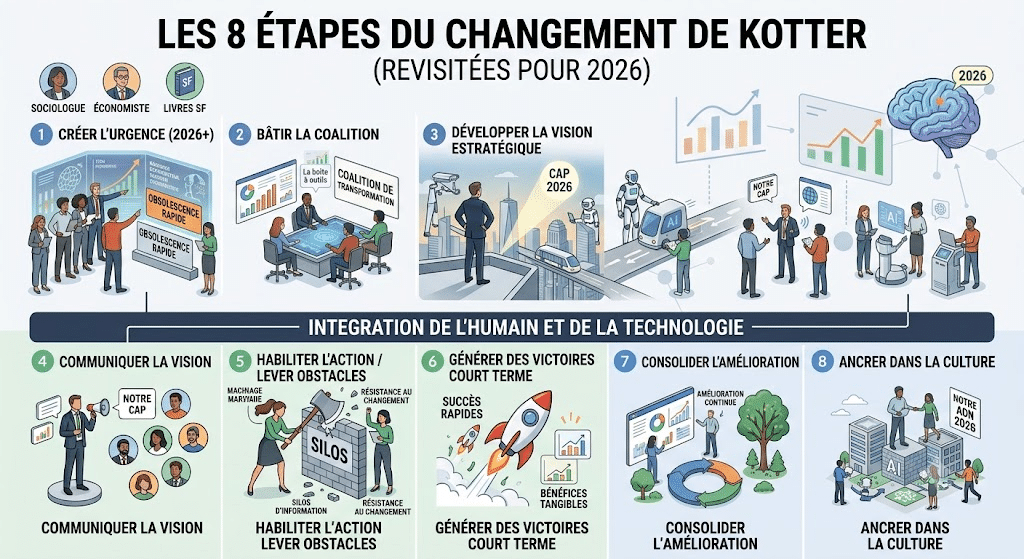
Successful change requires the mobilization of managers and their commitment. He recommends training managers in their role as change agents through his model so that they are relays of change.
- Methodological focus: Kotter’s 8 stages of change
4/ The collaborative and internalized approach (2000s to 2020s)
The relative success of instrumental approaches, digital projects and innovation imperatives have shown the interest of co-construction approaches and the fact of internalizing skills.this is change.
From change to global transformation: the 2026 vision
The transformation approach for a macro vision today
Change management, designed to support change in a micro way, is now complemented by transformation management. This aims to ensure the deep anchoring of projects, their agility in the face of disruptions and their strategic coherence.
Designed in particular by David Autissier and Jean-Michel Moutot, this latest paradigm is based on a 3-phase model:
- Define : this phase takes place upstream. It makes it possible to explain the change to the company’s stakeholders so that they know their role and can take ownership of it.
- Experiment: This phase consists of a workshop cycle and a piloting cycle. Employees experiment with various practices during participatory workshops. We then carry out surveys to validate the most suitable practices.
- Anchor: This phase mainly includes monitoring transformation projects within the company. It aims for the sustainable adoption of new working methods and the measurement of real impacts in the organization.
There is always an element of the unknown in change, even if we constantly try to theorize it.
