
In large organizations, every outbound touchpoint engages the brand. However, one channel is often left to individual initiative: the email signature.
On the scale of a group of several thousand employees, this represents hundreds of thousands of emails sent each month. So many uncontrolled impressions, sometimes incoherent, rarely controlled.
The question is therefore no longer aesthetic. It is organizational: how can we transform the email signature into a structured, governed and measurable channel at group level?
To help you see things more clearly, Letsignit presents to you today the formats and logic that are essential today in large companies.
1. Standardize without rigidifying: the corporate base.

In a multi-entity, multi-country, multi-brand environment, the signature becomes an issue of global consistency.
A structured corporate format allows:
- to impose a clear hierarchy of information;
- to harmonize logos and legal notices;
- to ensure consistent compliance;
- to guarantee readability in all environments (desktop, mobile, webmail).
The objective is not only visual. It is strategic: establishing a group standard, while leaving room for local adaptation when necessary.
2. Transform each email into an activation point.
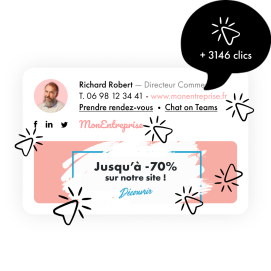
On a large scale, the email signature becomes a continuously distributed internal media.
Integrating a campaign banner, a call-to-action to an event or a link to strategic content allows you to activate this channel without additional media investment.
In a group of 5,000 employees, this can represent several million organic impressions per quarter.
The signature is no longer a simple footer. It becomes a relay of business priorities.
3. Segment intelligently by function and entity.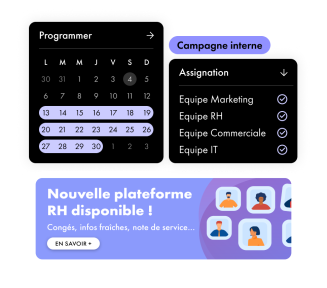
In a complex organization, not all employees carry the same message.
Adapting the signature according to functions, business units or countries allows the discourse to be aligned with field issues:
- sales teams direct people to make appointments;
- HR promotes the employer brand;
- support directs to support resources;
- management relays speeches and strategic content.
Same structure. Contextualized messages. Reinforced impact.
4. Integrate mobile constraints from the design stage. 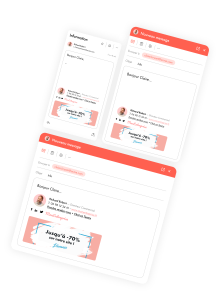
A significant portion of professional emails are viewed on smartphones. Ignoring this use amounts to mechanically reducing the effectiveness of the channel.
A mobile-first format (single column, light visuals, clear hierarchy) ensures that the message remains readable and actionable, whatever the environment.
For a Dircom, it is a brand experience issue.
For an IT department, this is an issue of technical standardization.
5. Manage, measure, industrialize.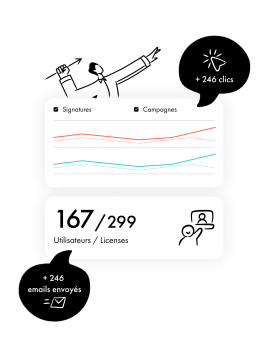
The real difference no longer lies in design, but in governance.
Centralized deployment, real-time updates, simultaneous activation on several entities, monitoring of clicks and performance, comparative tests to optimize messages: the email signature is now entering into a logic of industrialization comparable to that of other digital channels.
At this stage, it is no longer a simple static element at the bottom of the email, but a channel managed at group level. And like any strategic channel, it poses a broader question: that of its place in digital governance and in the overall alignment between communication, IT and business performance.
Take back control of an already omnipresent channel.
The email signature is one of the few channels present in every professional interaction. It does not depend on an algorithm or a media budget. It is already activated, every day, by all teams.
Maturity consists of regaining control of this diffuse flow. To structure it. To measure it. To align it with strategic priorities.
The most advanced organizations no longer wonder if the email signature is useful.
They are wondering how to fully integrate it into their digital governance.
Want to test the #1 email signature solution for your business? Discover Letsignit!
